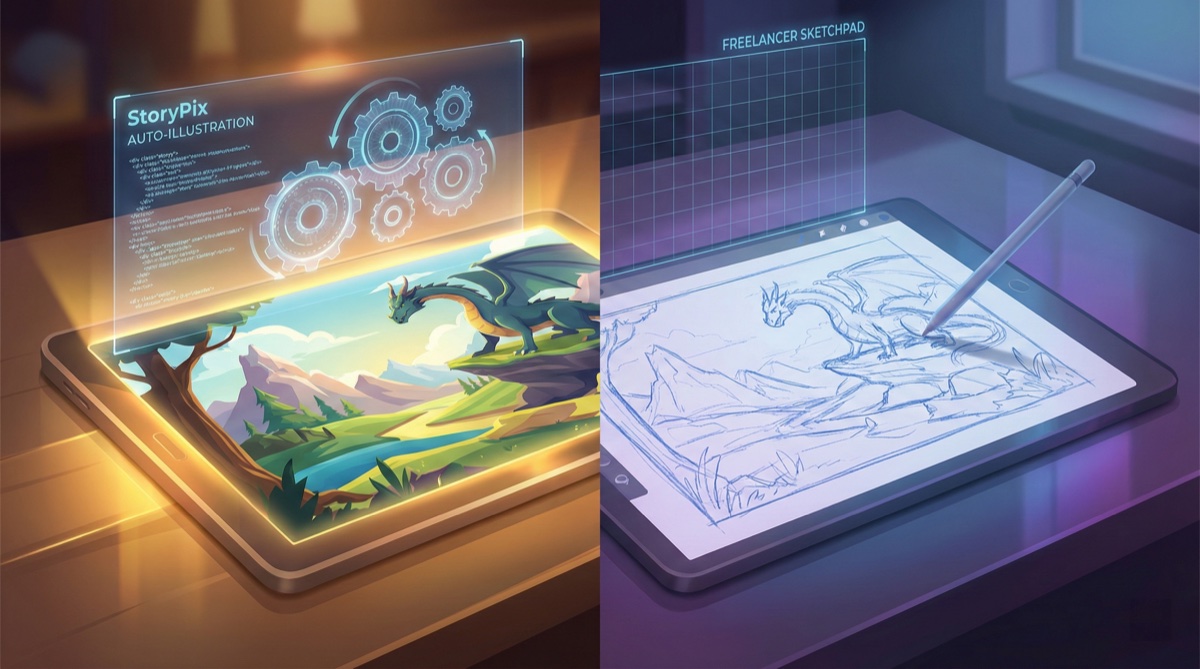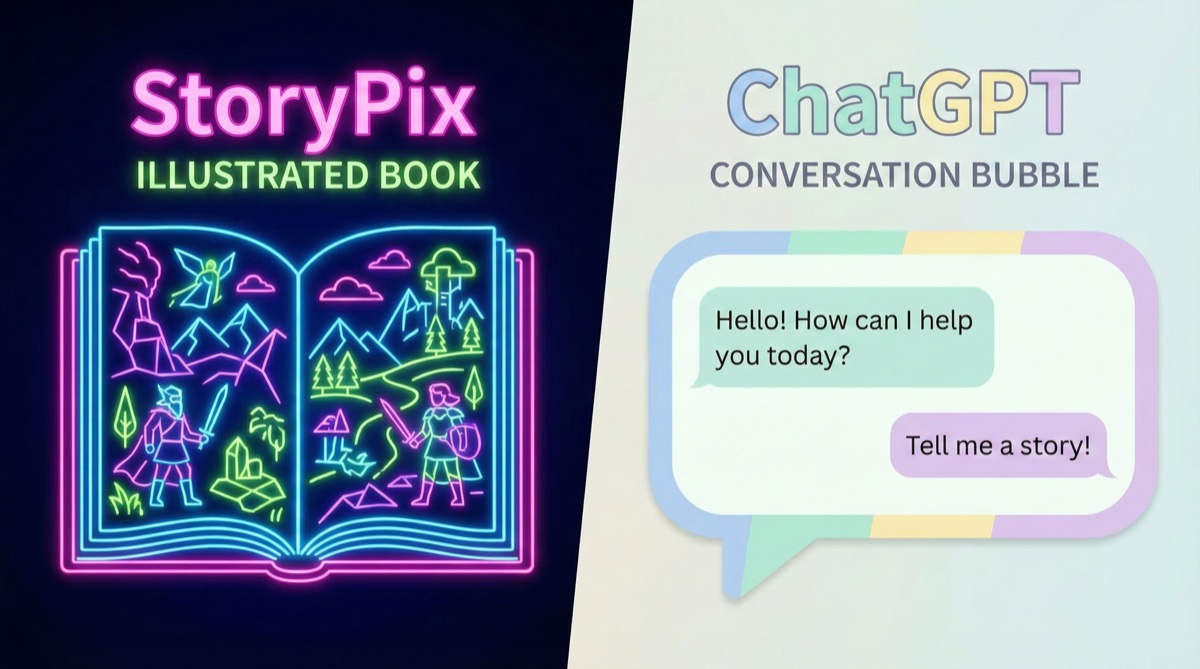
Parents looking for the best AI to create children's stories face a real choice: use a powerful general-purpose tool like ChatGPT, or a purpose-built platform like StoryPix. Both can generate imaginative stories for kids. But only one produces a finished illustrated book — complete with pictures, voiceover, and export options — in a single session. This comparison breaks down exactly where each tool excels and which one is right for your situation.
Quick Verdict
| Feature | StoryPix | ChatGPT |
|---|---|---|
| Story generation | Yes | Yes |
| Integrated illustrations | Yes (per page, 8 art styles) | No (DALL-E is separate) |
| Page-by-page layout | Yes | No |
| Voiceover / audio | Yes (60+ voices) | No |
| Video export | Yes | No |
| PDF / ePub export | Yes | No |
| Age-group targeting | Yes | Manual prompting required |
| Character consistency | Yes | Inconsistent |
| Language support | 29+ languages | Many, but no structured output |
| Age-appropriate guardrails | Built-in | Limited |
| Learning curve | Very low | Moderate |
| Free tier | Yes | Yes (limited) |
| Purpose | Children's illustrated stories | General-purpose AI assistant |
ℹ️ If your goal is a finished, shareable illustrated children's book — with pictures, audio, and a layout ready to share or print — StoryPix is purpose-built for exactly that. If you need a general writing assistant that can also help draft a story, ChatGPT is one of the best general tools available.
What Is StoryPix?
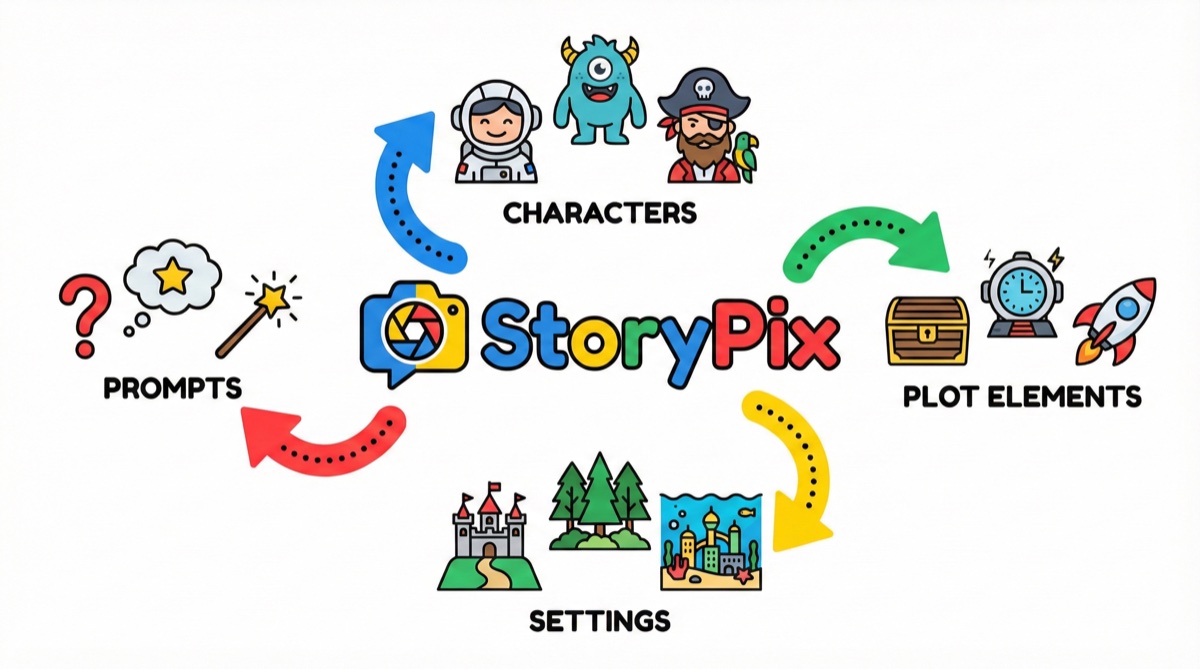
StoryPix is an AI story generator built specifically for children's illustrated books. You provide a simple idea — a character name, a theme, a setting — and StoryPix generates a complete illustrated story with matched artwork on every page. The platform handles the entire production pipeline: story writing, scene illustration, voiceover narration, and export to video, PDF, or ePub.
The platform is designed for parents, grandparents, and educators who want to create personalized storybooks without any design, writing, or technical skills. Every part of the workflow is built around one outcome: a finished illustrated children's book.
Key features at a glance:
- Story generation with age-group targeting (toddler through middle-grade)
- 8 distinct art styles, from watercolor to cartoon to fantasy
- Illustrations matched to each story page automatically
- Character design system for consistent appearance across pages
- 60+ AI voices for narration in multiple languages
- Video export, PDF export, and ePub export
- 29+ language support with native script output
- Age-appropriate content guardrails built into the system
What Is ChatGPT?
ChatGPT, developed by OpenAI, is a general-purpose large language model. It is one of the most capable AI writing tools available and can produce children's stories that are creative, age-aware, and highly customizable through detailed prompting.
ChatGPT is not built for children's books specifically. It is a conversational assistant that can handle an enormous range of tasks: writing, coding, analysis, tutoring, translation, and more. For storytelling, it performs well — but it requires the user to assemble the final product themselves.
What ChatGPT can do for children's stories:
- Generate imaginative, well-structured stories based on your prompt
- Adjust tone, complexity, and style when instructed
- Iterate quickly based on feedback in the chat
- Use DALL-E (via ChatGPT Plus) to generate images — though separately from the story
- Translate stories into other languages
What requires additional work outside ChatGPT:
- Generating matched illustrations for each page (DALL-E images are standalone, not page-integrated)
- Creating a layout or book format
- Adding narration or audio
- Exporting to PDF or any shareable format
- Ensuring character appearance stays consistent across multiple images
Head-to-Head Comparison
1. Story Quality
Both tools produce genuinely good children's stories. The quality difference is less about raw language ability and more about structure and targeting.
ChatGPT is an exceptional language model. With a well-crafted prompt, it can generate stories with strong narrative arcs, memorable characters, and age-appropriate vocabulary. Experienced users who know how to prompt effectively will find ChatGPT extremely flexible — you can specify reading level, story arc, moral lesson, character traits, and narrative voice in detail.
The limitation is that this flexibility requires effort. Parents who simply want a quick, good story without learning prompt engineering will spend time iterating before getting results they are satisfied with.
StoryPix generates stories with structure built into the system. Age-group presets, style selections, and character inputs feed into a generation pipeline calibrated for children's literature. The output is consistently formatted for illustrated book pages — scenes are appropriately paced, language is matched to the selected age group, and the story is structured to pair naturally with illustrations.
For parents who are not experienced AI users, StoryPix produces better results faster. For parents who enjoy crafting detailed prompts, ChatGPT offers more creative control over the text itself.
Winner: Tie — ChatGPT for advanced prompt users; StoryPix for speed and consistency.
2. Illustrations
This is where the comparison becomes most clear-cut.
ChatGPT can generate images through DALL-E integration (available in ChatGPT Plus). However, these images are generated independently from the story. There is no page-by-page layout, no automatic scene matching, and no mechanism to keep a character's appearance consistent from one image to the next. A child illustrated as having red hair and a blue coat in page one may look entirely different by page five.
To create an illustrated book using ChatGPT, you would need to: generate images one by one, prompt carefully for consistency, then manually assemble pages in a separate design tool like Canva or Adobe Express. For most parents, this process is time-consuming and technically demanding.
StoryPix generates illustrations automatically matched to each page of the story. The system identifies scene descriptions within the story and produces corresponding artwork. The character design system maintains visual consistency across the full book — the same character looks like the same character throughout.
StoryPix offers eight art styles to choose from:
- Watercolor
- Cartoon
- Fantasy illustration
- Storybook classic
- Pastel
- Bold graphic
- Pencil sketch
- Digital painterly
Each style produces a consistent aesthetic across the entire book, not just individual pages.
💡 When creating a story in StoryPix, spend a moment on the character design step. Defining your main character's appearance — hair color, clothing, distinctive features — significantly improves consistency across all illustrated pages.
Winner: StoryPix, significantly.
3. Voiceover and Audio
ChatGPT has no built-in voiceover or audio narration feature. Generating audio from a ChatGPT story requires copying the text to a separate text-to-speech service, selecting a voice, and then combining the audio with your book layout outside the platform. This is a multi-tool workflow with no native integration.
StoryPix includes voiceover narration as part of the story creation workflow. Choose from 60+ AI voices across multiple languages. The narration is matched to each page of the story and can be exported as part of a video file or as standalone audio. For children who are not yet reading, having the story read aloud is a significant feature — and it is one ChatGPT simply does not offer natively.
Winner: StoryPix.
4. Language Support
ChatGPT supports a large number of languages and can generate children's stories in most of them. Quality varies by language — English, Spanish, French, German, and Chinese generally perform well — but the output is plain text with no structured multilingual layout.
StoryPix supports 29+ languages with native script output and multilingual export. A bilingual parent can create a story in both English and Mandarin, for example, and produce a finished book in both languages. The platform was built with multilingual families in mind, and the language quality is consistent across supported languages.
ℹ️ StoryPix was originally developed for bilingual Chinese-English families, which is reflected in its strong CJK language support. For families raising children with two home languages, this is a meaningful practical advantage.
Winner: StoryPix for structured multilingual output; ChatGPT for raw language breadth.
5. Export Options
ChatGPT has no export functionality specific to children's books. The output is text in a chat window. Saving a story requires copying the text manually. Creating a PDF, ePub, or video requires entirely separate tools.
StoryPix exports to multiple formats directly from the platform:
- Video — narrated story with illustrations, suitable for sharing or watching together
- PDF — printable storybook layout, suitable for printing at home or a print shop
- ePub — digital book format compatible with most e-readers
For parents who want a physical printed book, the PDF export is particularly valuable. For grandparents and family members who want to watch a story on their phone or tablet, the video format is immediately shareable.
Winner: StoryPix.
6. Ease of Use
ChatGPT has a broad and growing user base, and many parents are already familiar with the interface. The conversation-based format is intuitive for generating and refining a story through back-and-forth dialogue. However, for the specific goal of creating a children's illustrated book, the workflow is not linear. Users must manage story generation, image generation, layout assembly, and export through separate tools and steps.
StoryPix has a single, linear workflow designed for the specific outcome of a finished illustrated book. Enter a character name and premise, select age group and art style, and the platform handles the rest. There are no tools to assemble, no external services to connect, and no design skills required. The average time from idea to finished illustrated story is under ten minutes.
For parents who are not regular AI users, StoryPix is significantly easier to use for this specific task. For parents who are already comfortable with ChatGPT and have workflows established, the transition requires learning a new interface.
Winner: StoryPix for the specific use case; ChatGPT for users already in the ecosystem.
7. Pricing
ChatGPT offers a free tier with access to GPT-4o, including some image generation. ChatGPT Plus costs $20/month and provides expanded access including higher image generation limits. However, generating a full illustrated book with consistent images requires significant Plus usage, and there is no children's book-specific pricing or free illustrated book tier.
StoryPix offers a free tier with 300 one-time credits — enough to create one complete illustrated story and try the full workflow with your child. Paid plans provide higher monthly credit allowances, additional voice options, priority generation, and expanded export formats. See the StoryPix pricing page for current plan details.
For parents who only occasionally want to create a story, the free tier on both platforms is a reasonable starting point. For regular use — weekly or bi-weekly bedtime stories — StoryPix's purpose-built pricing structure typically offers more value per illustrated book than assembling a workflow through ChatGPT Plus plus additional tools.
💡 Start with StoryPix's free tier to create your first illustrated story. You do not need a credit card to register, and the free stories are fully illustrated with voiceover — not a limited preview.
Winner: Comparable at entry level; StoryPix for regular illustrated book creation.
Who Should Choose ChatGPT for Children's Stories?
ChatGPT is the better choice if:
- You are already a regular ChatGPT user with an established workflow
- You want maximum creative control over every word of the story and are comfortable with detailed prompting
- You need a general-purpose assistant that can also write stories — not a dedicated story tool
- You plan to manually assemble the illustrated book yourself using design tools you already know
- The story text is the primary output and illustrations are secondary or optional
ChatGPT is genuinely excellent at generating creative, engaging children's stories when prompted well. If writing the story is the goal and the finished book experience is not, it is one of the best tools available.
Who Should Choose StoryPix for Children's Stories?
StoryPix is the better choice if:
- Your goal is a finished illustrated children's book, not just story text
- You want page-by-page illustrations that match each scene
- You want narration your child can listen to while following along
- You are creating stories in multiple languages or for bilingual children
- You want to export a shareable video or printable PDF without assembling it yourself
- You are not an experienced AI user and want a simple, guided workflow
- You create stories regularly and want a consistent, repeatable process
- Age-appropriate content guardrails matter to you
For parents creating personalized bedtime stories, classroom educators building curriculum materials, and grandparents who want to share illustrated stories with grandchildren, StoryPix is purpose-built for the outcome you want.
A Note on Honest Comparison
We built StoryPix to solve a specific problem: the gap between "AI can write a story" and "I have a finished illustrated book I can read with my child tonight." ChatGPT solves half of that problem very well. The story writing is excellent. But the illustrated book — the format a child actually experiences — requires an entirely different toolkit.
We are not the right tool if you want a general-purpose AI assistant. ChatGPT, Claude, and Gemini are all excellent choices for that. We are the right tool if you want to sit down with your child tonight with a personalized illustrated storybook you created this afternoon.
For a broader look at available tools, see our full comparison of AI story generators for kids, or our complete guide to AI story generation if you are new to the category.
ℹ️ Want to see what finished StoryPix stories actually look like before you create an account? Browse real illustrated stories in the [StoryPix gallery](/gallery) — no login required.
Final Recommendation
For parents who want to create illustrated children's books — complete with matched artwork, narration, and export options — StoryPix is the more capable and more efficient tool. ChatGPT produces excellent story text, but it does not produce a finished illustrated book without substantial additional work outside the platform.
For parents who want total creative flexibility and are comfortable assembling a multi-tool workflow, ChatGPT combined with DALL-E and a design tool can produce excellent results. The investment in time and skill is higher, but the creative ceiling is also higher.
For most parents — particularly those new to AI tools, those with limited time, and those who want to create stories regularly — StoryPix delivers a better outcome for this specific use case with significantly less friction.
Key Takeaways
- ChatGPT generates strong story text but requires separate tools to create an illustrated book
- StoryPix produces a complete illustrated book — story, artwork, narration, export — in a single workflow
- Character consistency across pages is a fundamental limitation of using general image generators; StoryPix addresses this with a dedicated character design system
- For multilingual families, StoryPix's structured 29+ language support is a practical advantage
- Both platforms offer free tiers — creating a story on each is the best way to compare for your specific needs
Try StoryPix free — create your first illustrated story at storypix.art/register. No credit card required. Your first illustrated, narrated story can be ready in under ten minutes.
Related Reading:
- How to Create a Personalized Children's Book with AI — step-by-step tutorial for first-time users
- Free vs Paid AI Story Generators — what you actually get at different price points
- AI Story Generator with Pictures: 7 Tools Compared — a broader look at illustrated story tools
- AI Bedtime Story Generator Guide — building a sustainable nightly story routine