For bilingual families, finding the right AI bilingual story generator is not just about convenience — it is about giving your child a tool that honors both of the languages they live in. The ability to read the same beloved story in Mandarin at bedtime and in English the next morning is something no previous generation of parents could offer their children so easily. Today, AI is making that possible, but not every tool handles bilingual children's books with equal care.
This guide compares the best AI tools available for creating bilingual children's stories in 2026. We evaluate each option against the criteria that matter most to multilingual families: translation quality, cultural sensitivity, age-appropriate vocabulary in each language, illustration consistency, and ease of use. Whether you are raising a Chinese-English child, a Spanish-English household, or navigating any other language pairing, there is a practical recommendation here for you.
Why Bilingual Stories Matter for Children
The research on bilingual child development is consistent and encouraging. Children who are regularly exposed to stories in both of their languages show stronger vocabulary acquisition in each language, better metalinguistic awareness (the ability to think about language itself), and greater cognitive flexibility overall.
A landmark study from the American Academy of Pediatrics found that reading to children in their heritage language — even when the surrounding society uses a different dominant language — significantly supports identity formation and family connection. Stories are not just literacy tools. They are the medium through which children understand who they are, where their family comes from, and what their community values.
Heritage language preservation is a specific concern for immigrant families. When parents can read stories in their native language — and then offer the same story in the language their child uses at school — they create a bridge rather than a divide. The story becomes a shared object that belongs equally to both languages, and by extension, to both parts of the child's identity.
The challenge, historically, has been access. Professionally translated bilingual children's books exist, but they are limited in variety, expensive, and rarely personalized to your child's specific interests, name, or experiences. This is the gap that AI bilingual story tools are beginning to fill.
What Makes a Good AI Tool for Bilingual Children's Books
Not all multilingual story tools are equally suited to this task. Before reviewing specific platforms, here are the criteria worth evaluating:
Translation and language quality. Generating a story in two languages is not the same as translating a story well. Machine translation tools can produce grammatically correct output that nevertheless sounds unnatural, uses adult vocabulary, or loses the rhythm and warmth that makes a children's story work. A good bilingual tool generates or adapts the story with genuine attention to age-appropriate register in each language.
Cultural sensitivity. A story generated in Chinese should feel culturally appropriate for a Chinese-speaking child — not just translated English idioms that land awkwardly in Mandarin. The best tools understand that language and culture are inseparable, especially for young readers.
Side-by-side vs. separate language versions. Some families want both languages visible on the same page, so the child can see the correspondence between them. Others prefer clean, separate versions that feel like distinct books in each language. A good tool supports both approaches.
Illustration consistency across languages. This is a detail that matters more than it seems. If a parent creates a story in English and then translates it to Spanish, the illustrations should remain identical. Inconsistent artwork across language versions undermines the feeling that this is the same story — and creates extra production work.
Age-appropriate vocabulary per language. A word that is appropriate for a five-year-old in English may have a different-register equivalent in Japanese. The tool should not simply translate at an adult level and assume the result is child-appropriate. Each language output needs to be calibrated for the target age group independently.
Ease of the multilingual workflow. How many steps does it take to produce a bilingual story? Some tools require a parent to generate the story twice, manage two separate documents, and manually align them. The best tools handle this with a single workflow.
The Best AI Tools for Bilingual Children's Stories in 2026
1. StoryPix — Best Purpose-Built AI Bilingual Story Generator
StoryPix is the only AI story platform built from the ground up with bilingual and multilingual families as a primary use case. The platform supports seven languages natively — English, Simplified Chinese, Traditional Chinese, Japanese, Korean, Spanish, and French — with more in development.
The bilingual workflow in StoryPix is designed around a single insight: parents should not have to create the same story twice. You create your illustrated story once, in your preferred language. When it is complete, a single button translates the entire story — text, page layouts, and voiceover narration — into any of the other supported languages. The illustrations remain exactly the same across all versions, which is precisely the consistency bilingual reading requires.
Several details set StoryPix apart specifically for this use case:
-
Age-appropriate vocabulary calibration per language. StoryPix does not simply run a machine translation pass on the English text. Each language output is reviewed against the age group you selected, ensuring that the Mandarin version of a story for a four-year-old actually reads like a story written for a four-year-old in Mandarin.
-
Traditional and Simplified Chinese as distinct options. This distinction matters enormously for Chinese-speaking families. Families from mainland China, Taiwan, Hong Kong, and the diaspora use different written standards. StoryPix treats these as separate languages rather than collapsing them.
-
Consistent illustrations across all language versions. The same AI-generated artwork appears in every language version of your story. There is no visual inconsistency to confuse young readers or create extra work for parents.
-
Voiceover narration in each language. Every translated version of the story includes native-quality AI voiceover in that language, so parents can play the story for a child in any supported language as an audio reading experience.
-
Heritage language preservation features. StoryPix includes optional prompts for incorporating cultural elements — festivals, foods, family structures, locations — that are specific to the language and culture being written in. A Spanish story can feel genuinely Mexican or Argentine or Spanish in its cultural texture, not just linguistically translated.
Pricing. StoryPix offers a free tier for getting started. Paid plans with full bilingual and export features start at accessible monthly pricing. See the full pricing page for current plans.
Best for: Families who want a complete, polished bilingual storybook — with illustrations and narration — in a fast, single workflow. Especially strong for Chinese-English, Japanese-English, and Spanish-English families.
💡 After creating your story in English, try the one-click translate feature to generate the Mandarin or Spanish version immediately. Your child can then listen to the same illustrated story in both languages on the same day — with the same artwork reinforcing comprehension in both.
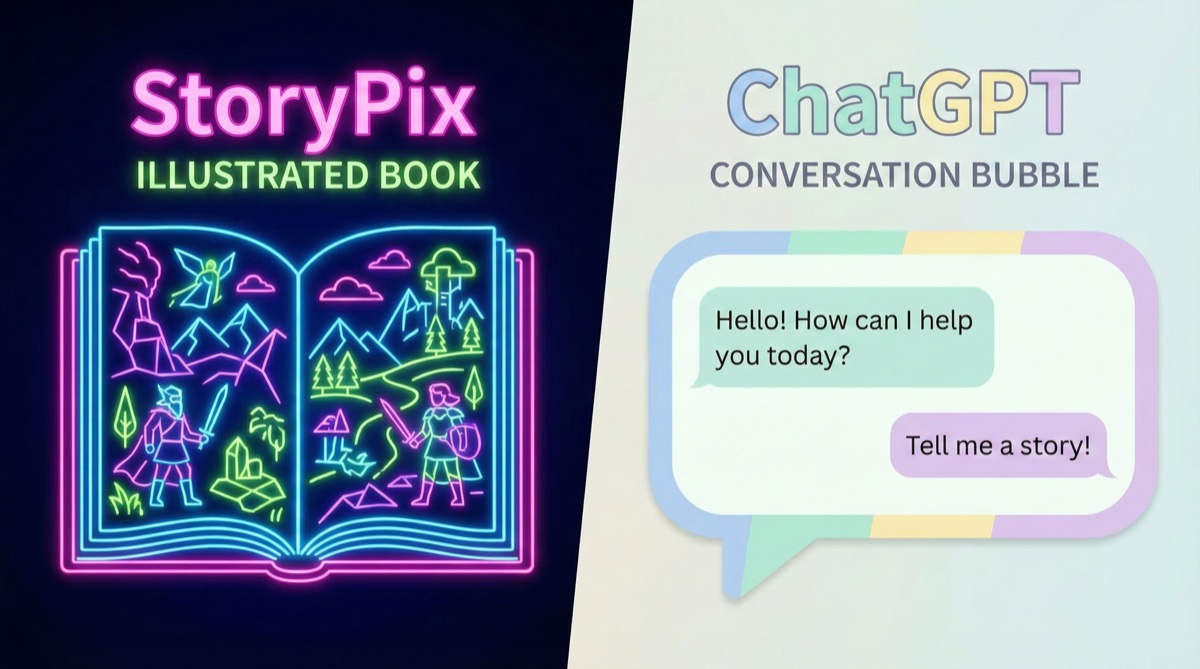
2. ChatGPT — Flexible but Manual Multilingual Writing
ChatGPT is a powerful general-purpose language model that can write children's stories in dozens of languages. For a bilingual parent who is comfortable working with AI tools and willing to do some assembly, it is a capable writing partner.
The strengths of using ChatGPT for bilingual stories are real. You can write detailed prompts specifying the language, age group, vocabulary level, cultural context, and tone you want. ChatGPT generally produces fluent, readable text in major world languages. For parents who want creative control over every sentence, the conversational back-and-forth can be valuable.
The limitations for bilingual children's books, however, are significant:
-
No integrated illustrations. ChatGPT does not generate images. DALL-E image generation is available through ChatGPT but requires a separate workflow, and the results are not automatically laid out against story pages. You would need to manually match images to text sections.
-
No guaranteed age-appropriate vocabulary. ChatGPT will attempt to calibrate vocabulary when asked, but there are no built-in guardrails ensuring the output is appropriate for a specific age in a specific language. You are relying on prompt engineering rather than a purpose-built system.
-
Manual bilingual process. Producing the same story in two languages with ChatGPT means running the process twice — or asking ChatGPT to translate its own output, which introduces the risk of vocabulary drift and inconsistency between versions.
-
No export or layout. The end product is text in a chat window. Turning it into a readable storybook requires additional tools: a design application, an image editor, or a separate export platform.
-
No voiceover or narration. There is no built-in narration feature. Audio versions of the story require a separate text-to-speech service.
Best for: Parents who want maximum creative control over the writing process and are comfortable managing the illustration, layout, and export steps themselves. Not recommended for parents who want a finished bilingual storybook in a single session.
3. Google Translate Plus Manual Story Creation — Free but Labor-Intensive
Some parents attempt to create bilingual children's books by writing the story themselves (or with AI assistance) and then using Google Translate to produce the second-language version. This approach is free and accessible, but it comes with substantial drawbacks.
Google Translate has improved dramatically in recent years and produces acceptable results for many everyday translation tasks. For children's stories, however, the limitations are meaningful. Literary language — the rhythm, warmth, and imagery that makes children's books work — is precisely what machine translation handles least well. A sentence that sings in English may become mechanical and flat in Mandarin through a translation pass.
Vocabulary calibration is the other major issue. Google Translate does not know that your story is written for a three-year-old. It will translate at whatever register the source text implies, which may be fine in English but produce vocabulary that is too complex, too formal, or culturally misaligned in the target language.
There is also no story generation, no illustrations, and no export tooling. This is a translation utility, not a story creation platform.
Best for: Parents with writing skills in both languages who want to self-author a bilingual story and only need basic translation assistance for a language they are less fluent in. Not suitable for parents seeking a complete bilingual storybook solution.
4. Professional Translation Services — Highest Quality, Highest Cost
Professional human translators and children's book specialists represent the gold standard for bilingual translation quality. A skilled translator who specializes in children's literature can preserve the tone, rhythm, and cultural nuance of a story across languages in a way that no AI currently matches.
The trade-offs are straightforward. Professional translation is expensive — typical rates for a short children's book run from several hundred to over a thousand dollars, depending on language pair and translator experience. Turnaround time is measured in days or weeks, not minutes. And professional translation services do not generate the original story, produce illustrations, or handle export and layout.
For families who are publishing a bilingual children's book commercially, or who want heirloom-quality translations for a highly personal project, professional translation remains the benchmark. For parents who want to create personalized bilingual bedtime stories regularly and affordably, the cost and time requirements are prohibitive.
Best for: Commercial publishing projects, or families with a specific once-in-a-lifetime story (a grandparent's memoir, a family heritage project) where quality justifies the investment.
Side-by-Side Comparison
| Feature | StoryPix | ChatGPT | Google Translate | Professional Services |
|---|---|---|---|---|
| Bilingual story generation | Yes (7 languages) | Yes (many languages) | No | No |
| One-click translation | Yes | No (manual) | Yes (translation only) | No |
| Age-appropriate vocabulary per language | Yes (built-in) | Requires prompting | No | Yes |
| Integrated illustrations | Yes | No | No | No |
| Illustration consistency across languages | Yes | N/A | N/A | Depends |
| Voiceover narration | Yes | No | No | No |
| Cultural sensitivity features | Yes | Partial | No | Yes |
| Traditional + Simplified Chinese distinction | Yes | Partial | Yes | Yes |
| PDF / ePub export | Yes | No | No | No |
| Time to finished bilingual story | 15-30 minutes | Hours (manual assembly) | N/A (translation only) | Days to weeks |
| Cost per story | Low (subscription) | Moderate (subscription) | Free | High (per project) |
| Best for | Bilingual families | Writers with AI skills | Basic translation | Commercial publishing |
ℹ️ The comparison above reflects the most common use case: a parent wanting to create a complete, illustrated bilingual storybook for their child. For this specific need, StoryPix is the only tool in this list that handles the entire workflow — story generation, illustration, translation, narration, and export — without requiring external tools or manual assembly steps.
Ready to Create Stories in 7 Languages?
If you have been looking for a bilingual children's story tool that actually works the way multilingual families think about stories, StoryPix was built for exactly this.
Create your first bilingual story for free
How to Create a Bilingual Story with StoryPix: A Quick Walkthrough
Creating a bilingual story in StoryPix takes the same amount of time as creating a monolingual one. The translation is handled automatically. Here is how the process works from start to finish.
Step 1: Start a new story and choose your primary language. Select the language you are most comfortable writing the story prompt in. This is the language the story will be generated in first. StoryPix supports English, Simplified Chinese, Traditional Chinese, Japanese, Korean, Spanish, and French as primary creation languages.
Step 2: Enter your story idea and settings. Give the story a topic, select your child's age group, and choose an art style. You can be as brief ("a girl who learns to share her toys") or as detailed as you like. The more specific your prompt, the more personalized the output. You can also enter your child's name and a few personality details to make the story feel tailored.
Step 3: Generate the story and illustrations. StoryPix generates the full illustrated story — typically eight to twelve pages with one illustration per page. Review the output and request regeneration of any page you want changed.
Step 4: Translate the story to your second language. With your primary-language story complete, open the language panel and select the second language. StoryPix translates the full text, recalibrates vocabulary for the selected age group in the target language, and produces a complete second-language version with the same illustrations. The process takes under a minute.
Step 5: Add voiceover narration in each language. Select a voice for each language version. StoryPix offers multiple voice options per language, so you can choose a voice that sounds natural in both. The narration is generated automatically against each page.
Step 6: Export and share. Export your story as a PDF, ePub, or narrated video — in either or both language versions. Share it directly with family members in another country, or save it for your personal library.
For more detail on each step, see our complete guide: How to Create a Personalized Children's Book with AI.
Tips for Parents: Making Bilingual Reading Work at Home
Creating bilingual stories is only part of the equation. Here are practical strategies for making bilingual reading a sustainable and joyful part of your household routine.
Choose a language for each reading context, and stick to it. Many bilingualism researchers recommend the "one parent, one language" or "one place, one language" approach. If you consistently read the Mandarin version of a story at bedtime and the English version during the weekend, your child begins to associate each language with a specific context — which reinforces acquisition in both.
Let your child choose which version to read. Giving children agency over the language they hear a story in helps them take ownership of both languages. When a child asks for the "dragon story in Chinese," they are not just making a reading preference — they are actively practicing language identity.
Read the story in one language, then revisit it in the other. Familiarity with the story in one language creates a comprehension scaffold for the second. A child who knows exactly what the bear does in the English version will follow along much more easily in the Japanese version, even if their Japanese vocabulary is still developing. This comprehension transfer is one of the most powerful tools bilingual parents have.
Use the same illustrated story for both languages. This is why illustration consistency across language versions matters so much. When the pictures are identical, the child's brain automatically connects the two linguistic representations to the same image — strengthening both vocabulary sets simultaneously.
Involve grandparents and extended family in the heritage language version. If one of your family's languages is spoken primarily by grandparents or relatives abroad, sending them the same story in their language creates a shared reading experience across geography. A grandfather in Taiwan and a grandson in San Francisco can discuss the same illustrated story — just in different languages.
Do not worry about mixing languages in conversation. Code-switching — mixing languages within a single sentence or conversation — is a normal and cognitively sophisticated behavior in bilingual children and adults. It is not a sign of confusion. Enjoying a story that validates and celebrates both languages reinforces that mixing is acceptable and even wonderful.
See examples of what bilingual stories look like in the StoryPix gallery across different language pairs and art styles.
Frequently Asked Questions
Q: Can StoryPix create a story in one language and then translate it to multiple other languages?
Yes. Once you have a completed story in any of the seven supported languages, you can generate translated versions in any combination of the other six. Each translated version maintains the same illustrations and generates its own age-appropriate voiceover narration. You can have versions of the same story in English, Simplified Chinese, and Japanese, for example, all within a single StoryPix project.
Q: Is the Chinese-language output in StoryPix actually appropriate for young children, or is it machine translation quality?
StoryPix generates Chinese-language stories (both Simplified and Traditional) with age-appropriate vocabulary calibration specific to the age group you select. This is different from running a machine translation pass on an English text. The system is calibrated for children's literary register in Chinese, which means shorter sentences, simpler vocabulary, and culturally appropriate imagery — not translated English idioms that land awkwardly in Mandarin.
Q: My child is learning Spanish as a second language. Can StoryPix help?
Yes, and this is one of the strongest use cases for the platform. Creating a story in English and then generating the Spanish version gives you a ready-made immersion reading tool. Because the child is already familiar with the story content from the English version, they can engage with the Spanish version at a higher level of comprehension than their current Spanish proficiency would normally allow. This technique — using known content to scaffold new language exposure — is a well-established approach in second-language acquisition.
Q: What if the language I need is not among StoryPix's seven supported languages?
StoryPix currently supports English, Simplified Chinese, Traditional Chinese, Japanese, Korean, Spanish, and French. If your family's heritage language is not on this list, ChatGPT is the most flexible alternative for generating story text in less common languages, though you would need to manage illustrations and layout separately. The StoryPix language list continues to expand — check the pricing and features page for the most current information.
The Bottom Line
For bilingual families, the best AI bilingual story generator is not simply the one that produces text in two languages. It is the one that handles the full scope of what bilingual storytelling requires: language quality calibrated for children in each language, cultural sensitivity, consistent illustrations across language versions, and a workflow that does not require parents to do the work twice.
StoryPix is the only tool in this comparison that addresses all of these requirements within a single platform. ChatGPT offers flexibility for parents who want to write their own stories and manage the production themselves. Google Translate and professional services serve more specific, limited needs.
If you are a bilingual or immigrant parent who wants to give your child illustrated stories in both of the languages they live in — without weeks of effort or professional publishing budgets — the simplest path forward is to start with StoryPix.
Start your bilingual story today — it's free to begin
Also worth reading:
- Best AI Story Generators for Kids in 2026 — a broader comparison of illustrated story tools, not limited to bilingual features
- How to Create a Personalized Children's Book with AI — a step-by-step tutorial for first-time StoryPix users
- AI Bedtime Story Generator Guide — create nightly stories in multiple languages
- AI Story Generator: The Complete Parent's Guide — explore all creation features in depth
- What Is an AI Story Generator? — beginner-friendly intro for parents new to the concept