You have probably heard the term "AI story generator" somewhere recently — in a parenting Facebook group, a school newsletter, or a conversation with another parent. And if your reaction was somewhere between curious and confused, you are not alone.
This guide explains exactly what an AI story generator is, how it works, what to watch out for, and whether it is worth trying with your family. No technical background required. No jargon. Just clear answers to the questions parents are actually asking.
What Is an AI Story Generator? A Plain-Language Definition
An AI story generator is a software tool that uses artificial intelligence to write stories based on instructions you provide. You tell it what you want — a character name, a setting, a theme, a lesson — and it produces a complete written story in seconds.
The "AI" part refers to the same underlying technology behind tools like ChatGPT. These systems have been trained on vast amounts of text, which allows them to write in different styles, adjust complexity for different age groups, and follow creative prompts with surprising quality.
For parents, the practical meaning is simple: instead of searching for the right book at the library or reading the same story for the hundredth time, you can create a brand-new, personalized story featuring your child's name, favorite animals, or specific interests — in the time it takes to make a cup of tea.
ℹ️ AI story generators do not search the internet for existing stories. They generate original text from scratch every single time, which means every story is unique.
How Does an AI Story Generator Actually Work?
You do not need to understand the technology in depth to use these tools effectively. But a basic picture helps set realistic expectations.
Here is the user experience, simplified into four steps:
Step 1: You provide a prompt or settings. This might be as simple as "Write a bedtime story for a 5-year-old about a girl named Maya who befriends a dragon." Some tools offer guided forms where you fill in fields for character name, age group, theme, and story length.
Step 2: The AI writes the story. The AI processes your input and generates a complete story — usually within a few seconds. It selects vocabulary appropriate for the age group, builds a narrative arc, and follows the theme you specified.
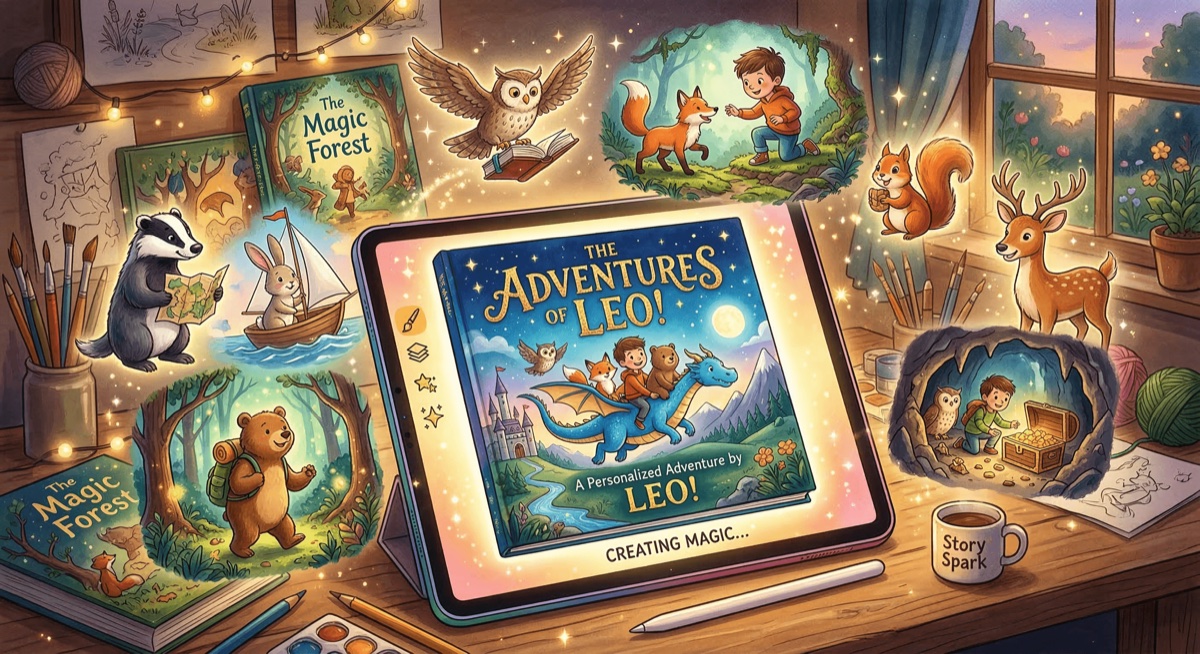
Step 3 (for illustrated tools): The AI generates pictures. More advanced tools like StoryPix take the story further and generate matching illustrations for key scenes, using a separate AI image model. This is what transforms a text document into something that actually looks and feels like a storybook.
Step 4: You receive the finished result. Depending on the tool, you might get plain text to copy, a formatted document to download, a PDF storybook to print, or even a video version to share.
The whole process — from entering your idea to holding a finished illustrated story — can take anywhere from 2 minutes to 30 minutes, depending on how much you customize.
The Three Types of AI Story Generators
Not all AI story tools are the same. There are three distinct categories worth knowing about.
Text-Only AI Tools (ChatGPT, Claude)
General-purpose AI assistants like ChatGPT and Claude can write high-quality children's stories on demand. You type a prompt, they write a story. The text quality is excellent — these tools handle vocabulary, pacing, and age-appropriate themes well.
The limitation is obvious: you get words on a screen, not a storybook. There are no illustrations, no formatting, and no export options. You would need to copy the text, format it yourself, and either find your own images or read it from a phone screen.
These tools are best suited for parents who want quick story ideas or raw text they can then use however they like.
Text Plus Illustrations (StoryPix and Similar Tools)
Purpose-built children's story tools combine AI writing with AI image generation to produce complete illustrated storybooks. You go through a setup process, the AI writes the story, generates matching illustrations for each scene, and the tool assembles everything into a formatted book you can read on screen, download as a PDF, or export as a video.
This category requires more setup time than a simple text prompt, but the result is something genuinely storybook-like — not just words on a page.
StoryPix is a good example of what this category produces. The gallery shows real stories created by parents using different art styles and themes.
Interactive or Chat-Based Storytelling
A smaller category of tools focuses on collaborative, back-and-forth storytelling. The AI starts a story, then asks the child what should happen next. The child's input shapes the direction of the narrative.
This format can be engaging for older children who want to participate in the story creation, but it requires supervision and active involvement — it is less suited for passive bedtime story use.
What Parents Should Know Before Using an AI Story Generator
Content Safety
The most common concern parents raise is whether AI-generated stories are safe for young children. The short answer is: it depends on the tool.
General-purpose AI assistants are not specifically designed for children. They have broad safety filters, but those filters are built for a general audience. When you use them without specific safety prompts, there is no guarantee the content will be age-appropriate.
Purpose-built children's tools handle this differently. StoryPix, for example, requires you to specify an age group (3 to 5, 6 to 8, or 9 to 12) at the start of every story. This setting shapes the vocabulary level, the emotional complexity of the plot, and the nature of any conflict or resolution. The system's content guardrails are calibrated specifically for children, not just "not adults."
💡 When evaluating any AI story tool for family use, look for age-group targeting (not just a generic "child-safe" claim), and check whether the tool has been designed specifically for children or adapted from a general-purpose product.
Story Quality
AI-generated stories have improved dramatically in recent years. A well-prompted story from a modern AI tool can be genuinely engaging, age-appropriate, and emotionally satisfying. The gap between AI-generated and professionally written children's books has narrowed considerably.
That said, AI stories benefit from parental guidance. The more specific your prompt, the better the result. "Write a story about a dog" produces something generic. "Write a story for my 6-year-old son Lucas, who loves dinosaurs and recently started kindergarten, about making a new friend" produces something personal and meaningful.
AI stories also benefit from a quick read-through before you share them with your child. Most of the time the output is perfectly good. Occasionally, a sentence will feel slightly awkward or a story beat will not land quite right. Treating AI as a first draft rather than a finished product is a healthy expectation.
Every Story Is Original
One question parents ask is whether AI-generated stories are copied from existing books. They are not. The AI generates new text from scratch each time, based on your specific inputs. The story about Maya and the dragon that you create today has never existed before and will never be generated in exactly the same way again.
This originality is one of the genuine advantages of AI storytelling — you never run out of new content.
Data Privacy
What happens to the story you create and the information you provide? This varies by tool and is worth checking before you start entering your child's name and interests into any service.
Reputable tools publish clear privacy policies. Look for policies that specify that user-generated content is not used to train AI models without consent, and that children's data is handled in compliance with applicable privacy laws (in the US, this includes COPPA; in Europe, GDPR).
The Real Benefits for Families
Personalization That Books Cannot Match
No published storybook features your daughter's name, her exact personality, her obsession with space exploration, and the specific lesson you want to reinforce this week. AI story generators can do all of that. Personalized stories hold children's attention in a different way than generic ones — hearing their own name in the narrative creates immediate engagement.
Unlimited Variety
A subscription to any AI story tool gives you access to unlimited new stories. You never hit the end of a book series or have to wait for a sequel. If your child goes through a phase of wanting only stories about volcanoes, or only stories where the main character is a cat, you can produce as many as needed.
Bilingual and Multilingual Support
For families raising children with more than one language, AI story tools offer something traditional publishing rarely does: stories in your home language. StoryPix supports story creation in English, Chinese, Japanese, Korean, Spanish, and French, with translation into 10 languages after creation. A bilingual family can create the same story in both English and Mandarin and read both versions on the same evening.
Cost Compared to Buying Books
Quality children's books typically cost between eight and twenty dollars each. A monthly subscription to an AI story tool that produces dozens of stories costs less than two or three books. For families who go through books quickly, the economics are favorable.
A Creative Activity to Do Together
Creating a story together — deciding on the character, choosing the setting, picking the art style — is itself a bonding activity. Children who are old enough to participate in the setup often feel genuine ownership over the finished story. It is something you made together, not something you bought.
Common Concerns, Honestly Addressed
"Will AI replace real books?"
No. AI-generated stories and traditionally published books serve different purposes. A beloved picture book by a skilled author-illustrator is a work of art — the craft of the language, the intentionality of every illustration, the cultural weight of a classic. AI stories are not competing with that.
What AI story generators do well is fill the gap between "we have read everything on the shelf" and "I need a new bedtime story tonight." They are supplementary, not substitutional.
"Is it actually safe?"
For purpose-built children's tools with proper age-targeting and content guardrails, yes. For general AI assistants used without specific safety prompts, it requires more care. Choose tools designed for children, not adapted for them.
"Can my child use it alone?"
For younger children (roughly under 8), AI story tools are best used as a parent-child activity. The setup process involves reading and writing, and a parent's involvement also adds an important layer of oversight for the output.
For older children (roughly 9 and up), supervised independent use is reasonable, depending on the specific tool and your family's guidelines around screen time and AI use. This is ultimately a parenting judgment call, not a technical one.
ℹ️ Many parents find that the story creation process itself — choosing themes, naming characters, picking an art style — becomes a regular creative activity they do together with their children, separate from actually reading the finished story.
"Do you need to be tech-savvy to use these tools?"
Not at all. The best children's story tools are designed specifically for parents with no design experience and no background in AI. StoryPix, for example, walks you through the process with a step-by-step wizard — you fill in prompts and make selections, and the AI does the technical work. If you can send an email and fill out an online form, you have all the technical skills you need.
How to Get Started
The fastest way to understand what AI story generators actually produce is to try one. Reading about them only gets you so far — seeing a real illustrated story built around your child's interests makes the concept concrete in a way that no description can.
A good starting point:
-
Visit the StoryPix gallery to see examples of finished AI-generated illustrated stories across different art styles and age groups. This gives you a realistic picture of what the output looks like.
-
When you are ready to try it yourself, create a free account and build your first story. The free tier includes enough credits for a complete story from start to finish.
-
For a detailed walkthrough of the creation process, the step-by-step tutorial covers every stage in detail.
If you want to compare different tools before committing to one, see our comparison of the best AI story generators for kids, which evaluates the leading options across illustration quality, safety, language support, and pricing.
Frequently Asked Questions
Do I need to know anything about AI to use an AI story generator?
No. Purpose-built children's story tools are designed for parents with no technical background. You fill in guided forms — your child's name, age, interests, preferred theme — and the AI handles everything else. You never need to understand how the AI works to get good results.
How long does it take to create a story?
It depends on the tool and how much you customize. With a simple text-only tool, you can have a story in under a minute. With a full illustrated storybook tool like StoryPix, the process takes 15 to 30 minutes — most of which is making creative choices about characters, art style, and story direction, not waiting for the AI.
Are AI-generated stories appropriate for all ages?
This depends on the tool. Purpose-built children's tools with age-group targeting adjust vocabulary, emotional complexity, and plot content based on the age range you select. General AI assistants do not automatically calibrate for children and require more careful prompting to ensure age-appropriate output.
Can I save or print the stories I create?
Most dedicated storybook tools offer download or export options. StoryPix allows export as PDF (in standard and spread layouts), ePub, and video. Text-only tools typically let you copy the text, but formatting and printing are up to you.
How is an AI story different from a story written by a person?
AI stories are generated algorithmically based on patterns learned from large amounts of text. They can be surprisingly good — age-appropriate, emotionally coherent, and genuinely enjoyable. The main practical difference is that AI can produce a personalized story in seconds, while a human author takes considerably longer. The main qualitative difference is that a skilled human author brings intentional artistic craft to every word; AI is very capable but not artistic in the same deliberate sense. For everyday family use, the gap is smaller than most parents expect.
The Bottom Line
An AI story generator is a practical tool for creating personalized, original stories for children — quickly, affordably, and without any creative or technical expertise. The technology has matured to the point where the output is genuinely good for everyday use: bedtime stories, travel entertainment, bilingual reading practice, or just a new adventure for a child who has exhausted the bookshelf.
It will not replace the books you love or the stories that have been passed down through your family. But for the Tuesday night when you need something new, something personal, and something that features your child's stuffed rabbit as the hero? An AI story generator is hard to beat.
Try creating your first free story at StoryPix and see what is possible.
Related Reading:
- AI Story Generator: The Complete Parent's Guide — detailed walkthrough of the 7-step creation process
- AI Bedtime Story Generator Guide — creating nightly personalized stories for kids
- Free vs Paid AI Story Generators — understand what you get at each price point
- AI Story Generator for Teachers — using AI stories in classroom and educational settings