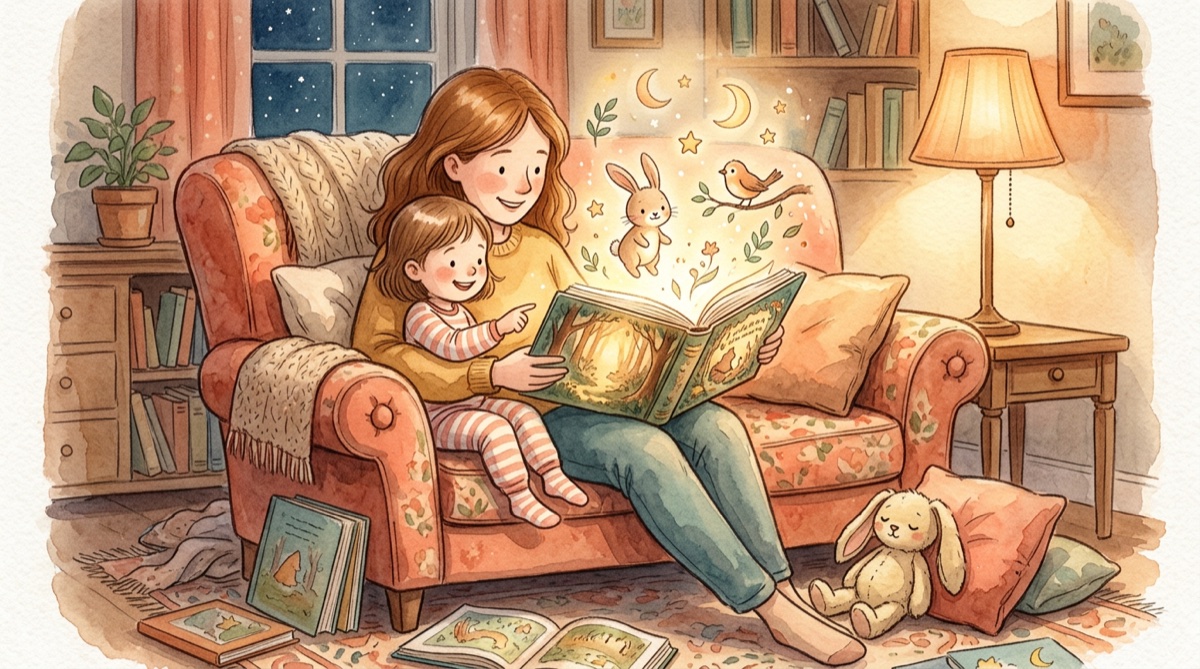
It is 8:15 PM. Your child is washed, in pajamas, and settled under the covers. They look up at you with those wide, expectant eyes and ask the question you have heard four hundred times this year: "Tell me a story."
You reach for the bookshelf. You have read every book on it. Twice. Some of them three times. Your child mouths the words along with you before you can even say them.
Every parent knows this feeling. The bedtime story tradition is one of the most meaningful rituals in childhood, but keeping it fresh — especially when you are exhausted at the end of a long day — is genuinely hard. This is exactly where an AI bedtime story generator changes everything.
In this guide, you will learn what makes a great AI-generated goodnight story, how to create one in minutes, and how to build a sustainable bedtime routine that neither you nor your child will ever get bored of.
The Real Problem with Bedtime Stories
The struggle is not that parents do not care about bedtime stories. Parents care deeply. The problem is structural:
You run out of material. A child aged 3 to 8 has a bedtime story every single night. That is 365 stories a year. Even the most well-stocked bookshelf has limits, and even the most creative parent's imagination hits a wall when they are running on four hours of sleep and a strong cup of coffee.
Repetition dulls the magic. Children are comforted by familiar books, but over time even a beloved story loses its power to settle and engage. The tenth reading of the same picture book is a very different experience than the first.
Improvised stories are exhausting. Many parents can spin a story off the top of their head — but doing it consistently, at quality, when your own energy is at its lowest point of the day, is draining.
Every child wants something different. Your daughter is obsessed with horses this month. Your son will only accept stories about robots. A generic off-the-shelf book cannot always meet the very specific thing your child needs to feel seen and delighted.
The result is a nightly ritual that starts with intention and often ends in a parent mumbling through a half-remembered story while their child stares at the ceiling.
An AI goodnight story generator solves all of this. Let us talk about how.
How AI Transforms the Bedtime Story Routine
A modern AI bedtime story maker does four things that a bookshelf simply cannot:
1. Unlimited unique stories. Every generation produces something completely new. You will never read the same story twice unless you choose to.
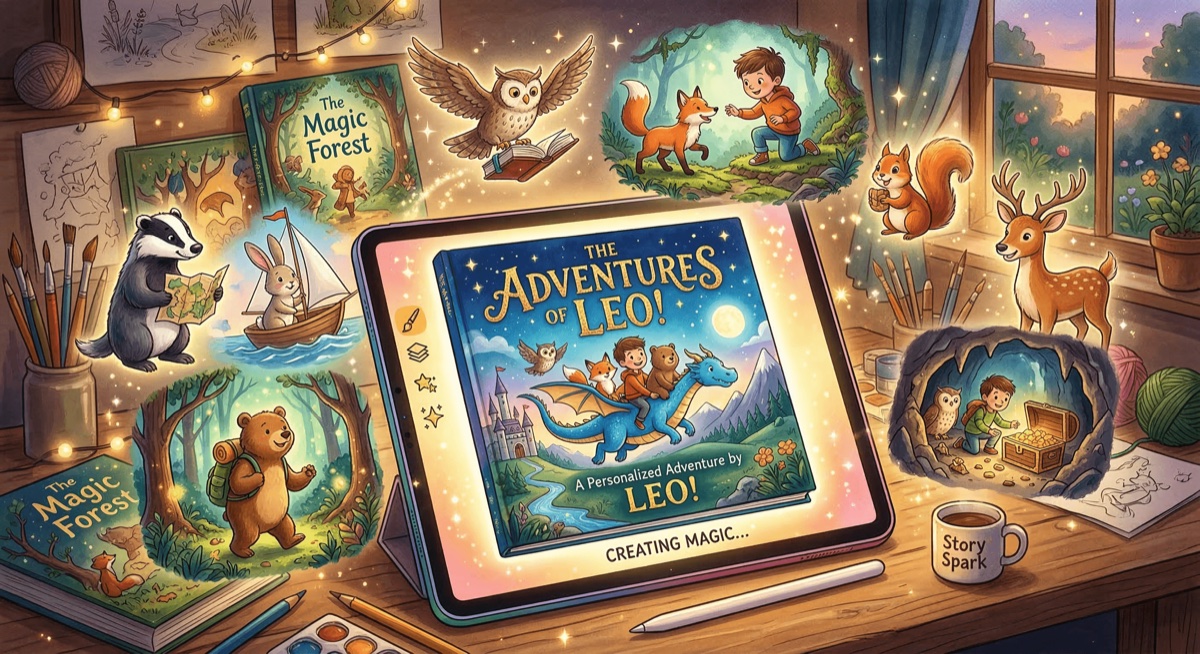
2. Deep personalization. You can give the AI your child's name, their favorite animal, their best friend's name, the thing they are scared of, the lesson they need to hear right now. The story reflects your child specifically, which is profoundly engaging for young readers.
3. Ready in minutes. You do not need to write anything. You describe what you want in a sentence or two, and the AI handles the rest. You can have a complete illustrated bedtime story in the time it takes your child to brush their teeth.
4. Illustrations included. The best AI bedtime story tools do not just produce text. They generate beautiful images your child can look at as you read — which is especially important for younger children who learn through pictures.
💡 The most effective bedtime stories with AI involve your child in the process. Ask them at dinner: "Who should the hero be tonight?" or "What kind of adventure should they have?" Then use their answer as your AI prompt. They will be far more engaged with a story they helped imagine.
What Makes a Great AI Bedtime Story
Not every AI-generated story is a good bedtime story. There are specific qualities that make a story genuinely suitable for winding a child down at night, rather than just entertaining them in the way a daytime story might.
Calming Tone and Pacing
A bedtime story should slow your child's nervous system down, not excite it. Good AI bedtime stories have:
- Gentle pacing — events unfold slowly, without sudden twists or high-stakes tension
- Soft, descriptive language — words that paint cozy pictures rather than trigger adrenaline
- Reassuring themes — characters who are safe, loved, and cared for
- A satisfying, peaceful ending — the hero reaches home, goes to sleep, finds comfort
When using an AI story generator, guide it toward calming outcomes by framing your prompt around comfort and resolution. Instead of "an adventure," ask for "a gentle adventure that ends at home."
Appropriate Length
A bedtime story that runs too long will either put your child to sleep before it ends (fine, actually) or keep them wired and engaged when you need them to be drifting off. The sweet spot for most ages is:
- Ages 2–4: 3–4 pages, very short text per page
- Ages 4–7: 4–6 pages, a clear simple arc
- Ages 7–10: 6–8 pages, slightly more complex
Most good AI bedtime story generators let you set page count. Use it. A 4-page story is almost always the right choice for a weeknight.
Age-Appropriate Vocabulary and Themes
The AI must be calibrated to your child's age. A story written for a 9-year-old uses concepts and vocabulary that are not calming for a 4-year-old — they might cause confusion, questions, and the opposite of sleepiness. Look for tools that let you set an age group before generating.
Themes to aim for at bedtime:
- Home, family, safety
- Nature, animals, gentle journeys
- Friendship and kindness
- Dreams, stars, nighttime itself
Themes to avoid at bedtime:
- Conflict without resolution
- Scary characters, even "friendly" scary ones
- Open endings that create suspense
- Anything that triggers big emotions — excitement, anger, fear
Beautiful Illustrations to Look at Together
Illustrated stories are not just for entertainment. For young children, looking at pictures together while a parent reads is a bonding ritual in itself. The best AI bedtime story generators produce genuine illustrations — not clip art or stock photos, but AI-rendered scenes that match your story.
Look for tools that let you choose an art style appropriate for bedtime. Watercolor and hand-drawn storybook styles tend to be softer and more calming than bright digital or anime styles.
Optional Voiceover for Tired Nights
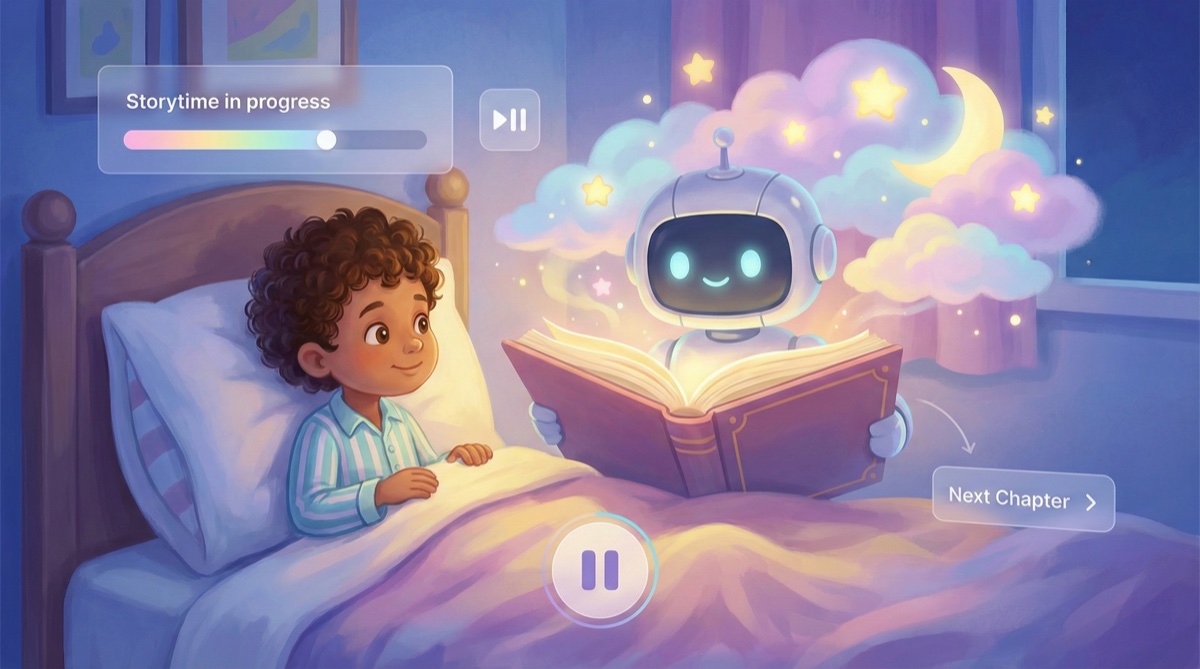
Some nights, you simply cannot read aloud. Your voice is gone. You are sick. You have been talking all day and your throat is done. On those nights, a voiceover feature on your child's bedtime story is a genuine lifesaver — not a replacement for your presence, but a tool that means the ritual still happens even when you are at your limit.
ℹ️ Research on bedtime routines consistently shows that the ritual itself — the quiet, the closeness, the transition signal — matters more than the specific content. An AI-narrated story with a parent sitting nearby still delivers the core benefits of the bedtime story ritual.
The Best AI Tools for Bedtime Stories
There are several AI tools parents can use to create bedtime stories. Here is an honest look at the main options.
StoryPix — Best Overall for Bedtime Stories
StoryPix is purpose-built as a complete illustrated children's storybook studio, and it is the strongest option specifically for bedtime use for several reasons.
Illustration quality is genuine. StoryPix generates real AI illustrations scene by scene, in art styles specifically suited to children's stories. For bedtime, the Watercolor and Storybook styles are particularly effective — soft, warm, calming visuals that feel like they belong in a classic picture book.
Page count control. You can set exactly how many pages you want. Choose 4 for a quick weeknight story, 6 for a weekend when you have more time. The story is structured to fit the length you specify, not padded or truncated.
Age group targeting. Setting the age group ensures vocabulary, sentence complexity, and themes are appropriate for your child right now — not for some generic "child."
Voiceover and video. StoryPix lets you add a soft narrated voiceover and export your story as a video. For nights when you need to rest your voice, you can play the story on a tablet while sitting with your child. The story still happens. The ritual still holds.
Character library. Once you create a character your child loves — say, a small fox named Pip — you can save that character and bring them back in future stories. This is the key to building a serialized bedtime story series, which children find enormously comforting.
Bilingual support. StoryPix supports multiple languages and bilingual mode. For families raising children in more than one language, bedtime is one of the most effective times for language exposure — the relaxed state makes absorption more natural.
See story examples in the StoryPix gallery to get a feel for what the finished product looks like.
ChatGPT — Good for Quick Text-Only Stories
ChatGPT can write a bedtime story in seconds based on a simple prompt, and for parents who just need words to read aloud, it works. You can ask for a calming story about your child's specific interests, specify a length, and get something reasonable quickly.
The limitations for bedtime use are significant, however. ChatGPT produces no illustrations. There is no voiceover. There is no export format designed for reading to a child — you are looking at text on a phone screen. You will need to do all the reading yourself, every time, with no visual element to share with your child.
ChatGPT is best used as a quick backup on nights when you have nothing ready and do not have time to use a dedicated tool.
Dedicated Bedtime Story Apps
Several apps exist specifically for bedtime stories — some are subscription audio services, some are ebook libraries, and a smaller number attempt AI generation. As a category, these tools tend to offer less creative flexibility than a full AI story generator. You often cannot put your child's name and specific interests into the story in a meaningful way. The personalization is surface-level.
For parents who want genuine customization — the child's actual personality, interests, and character woven into each story — these apps generally fall short of what a purpose-built AI bedtime story maker can deliver.
If you want to see how StoryPix compares to the broader field, the full AI story generator comparison covers the key tools side by side.
How to Create the Perfect AI Bedtime Story with StoryPix
Here is a practical step-by-step guide for creating a bedtime story with StoryPix on any given night.
Step 1: Choose age group and a short page count.
Open StoryPix and start a new story. Set your child's age group — this shapes vocabulary, themes, and sentence length automatically. Then set the page count to 4 pages for a weeknight. This gives you a complete story arc in about 5–7 minutes of reading time, which is ideal for most bedtime routines.
Step 2: Pick a calming theme using the custom prompt.
In the theme field, be specific and frame it around comfort. Instead of "adventure," write something like: "a gentle adventure about a small bunny named [child's name] who gets a little lost in a meadow and finds her way home just as the stars come out." The specificity is what makes AI-generated personalized bedtime stories feel magical rather than generic.
Step 3: Select Watercolor or Storybook art style.
Both of these styles produce soft, warm illustrations that complement the mood of a bedtime story. Avoid brighter, higher-contrast styles like 3D or comic book for nighttime use — they are visually stimulating rather than calming.
Step 4: Generate and review.
StoryPix generates the story and illustrations. Review each page quickly. If a scene feels too intense or an illustration is not quite right, you can regenerate individual pages without starting over. The whole generation process typically takes 2–3 minutes.
Step 5: Add a soft voiceover.
If you want the option to play the story narrated, select a voice and generate the voiceover. Choose a slower, softer voice from the available options — the narration pace matters as much as the content for a bedtime story.
Step 6: Save to your library.
Save the story to your StoryPix library. It will be there for repeat readings — some children love hearing the same AI story multiple nights in a row once they have bonded with it. And unlike a bookshelf book that never changes, you can always create a new chapter in the series whenever your child is ready.
Create tonight's bedtime story with StoryPix — free to start
Pro Tips for AI Bedtime Stories That Actually Work
After creating dozens of AI bedtime stories for children of different ages, here are the strategies that genuinely make a difference.
Build a series with the same character.
Children develop deep attachment to recurring characters. Once you find a character your child responds to — a small dragon, a brave girl with red boots, a cat who lives on the moon — bring that character back regularly. Use the StoryPix character library to save the character's visual design and description, so continuity is easy across stories.
Let your child choose tomorrow's topic at breakfast.
Make the creation of the next bedtime story part of the morning routine. Ask at breakfast: "Who should be in tonight's story?" or "What should happen to Pip the fox tonight?" Your child spends the whole day in low-level anticipation of a story they helped design. By bedtime, they are invested before you have even opened the app.
Use bilingual mode during this relaxed state.
If you are raising a child in a second language or want to expose them to one, bedtime is one of the best times to do it. A relaxed, drowsy brain absorbs language patterns in a different way than an alert, task-focused one. Creating bilingual bedtime stories — where the text appears in both English and a second language — is one of the most natural ways to build early bilingual literacy. The guide to bilingual AI story tools goes deeper into this if it is relevant to your family.
Export as video for nights when you need a break.
There is no shame in putting on a soft, narrated video story and sitting beside your child on nights when reading aloud is genuinely beyond you. The ritual — the quiet, the closeness, the transition from day to night — still happens. StoryPix video export is designed exactly for this use case.
Keep a running list of prompts that worked.
When a story lands particularly well — your child asks for it again, or it produces a calm and quick sleep — write down the prompt you used. Build a small library of proven bedtime prompts for your child. Over time you will develop an intuition for what themes, characters, and structures work for your specific child.
💡 The single most effective bedtime story prompt structure is: "[Child's name or a character they love] + [a small problem] + [gentle resolution involving home, sleep, or safety]." This arc mirrors what the bedtime ritual is designed to do psychologically — acknowledge the day, move through a small challenge, and arrive at safety and rest.
Building a Sustainable Bedtime Story Routine with AI
The goal is not a one-off story. The goal is a ritual that works every night for years.
Here is what a sustainable AI-assisted bedtime story routine looks like in practice:
The two-minute prep. Before bedtime begins, spend two minutes creating the story. You can do this while your child is brushing teeth. By the time they are in bed, the story is ready. There is no scrambling, no decision fatigue.
The reading ritual stays yours. Even when using an AI-generated story, the act of reading to your child — the physical closeness, the shared looking at pictures, your voice — remains the heart of the experience. AI generates the content. You deliver the connection.
Rotate between new and familiar. Children need both novelty and comfort. Create new stories two or three nights a week, and return to favorites on the other nights. The AI-generated stories that really landed can be visited again and again. Your library grows over time into a collection that is genuinely your family's own.
Match story length to the child's energy level. On nights when your child is particularly wound up, choose a shorter story — 3 or 4 pages — and read slowly. On nights when they are already half-asleep, even a short story may not be necessary. The flexibility of generating stories at any length is one of the practical advantages of a custom bedtime story generator over a fixed library of books.
Let the routine evolve as your child grows. The bedtime story needs of a 4-year-old and an 8-year-old are genuinely different. AI story generators grow with your child — you adjust the age group setting, the story complexity increases naturally, and the themes can mature alongside them. You do not need to buy new books at every developmental stage.
For a complete walkthrough of creating illustrated storybooks beyond just the bedtime use case, the full creation tutorial covers the entire StoryPix workflow in detail.
Frequently Asked Questions
Is AI-generated content safe for children at bedtime?
Yes, when you use a tool designed specifically for children's content. StoryPix applies age-appropriate content filtering at the generation level — not just a content warning after the fact. Setting the age group ensures the themes, vocabulary, and scenarios stay genuinely suitable for your child. If you use a general-purpose AI like ChatGPT, you will need to review the output before reading it aloud, as general tools are not specifically calibrated for young children.
How long does it take to generate a bedtime story?
With StoryPix, a 4-page illustrated bedtime story typically generates in 2–3 minutes. You can realistically create a new story while your child brushes their teeth and is ready to read by the time they are in bed.
Will my child get bored of AI stories the same way they get bored of books?
Unlikely, for a simple reason: every story is different. The attachment that children develop to specific physical books — the cover, the smell, the exact text they have memorized — develops because the book is fixed. AI stories are unlimited and always new. Your child can build attachment to recurring characters and story worlds you create together, while the specific story is always fresh.
Can I use AI bedtime stories if English is not our primary language?
Yes. StoryPix supports multiple languages and can generate stories in languages other than English. You can also use bilingual mode to produce stories in two languages simultaneously — which is particularly useful for families who want to maintain a heritage language or introduce a second one during the naturally receptive bedtime state.
How much does it cost to create AI bedtime stories with StoryPix?
StoryPix has a free tier that lets you create stories without any upfront commitment, so you can try it before deciding on a plan. For families who want to create stories regularly, the paid plans provide access to all art styles, longer stories, voiceover, and video export. You can review current plan options on the pricing page.
Can I print the AI bedtime stories?
Yes. StoryPix offers PDF export, so you can print your AI bedtime stories as physical books. Some parents create a printed version of particularly beloved stories — something the child can hold, re-read, and even take to school to share.
Conclusion
The bedtime story is one of the most powerful tools you have as a parent. It settles your child, builds language, grows your bond, and creates memories that last far beyond childhood. The barrier has never been caring — it has always been running out of material, running out of energy, and running out of new things to say.
An AI bedtime story generator removes every one of those barriers. With StoryPix, you can create a beautiful, illustrated, personalized goodnight story in the time it takes your child to put on pajamas. You can build a library of stories that grows with your family. You can bring the same beloved character back night after night, or introduce something brand new whenever your child's interests change.
The ritual stays yours. The magic stays real. The stories are just unlimited.
Never run out of bedtime stories — start creating with StoryPix tonight
Related Reading:
- AI Story Generator: The Complete Parent's Guide — explore all 7 steps of the creation process
- StoryPix vs ChatGPT for Children's Stories — honest comparison of both approaches
- Best AI Tools for Bilingual Children's Stories — ideal for multilingual bedtime routines
- What Is an AI Story Generator? — beginner-friendly guide to the technology